

A 360° orbit LoRA for MiniMax H3: what it does and where it breaks
Disclosure: this is an internal test. We did not make this LoRA and we do not sell it. All the videos are AI-generated.
A community LoRA makes MiniMax H3's first/last-frame model turn a subject a full 360° and come back to the start frame. We tested it on our RTX 4090 with three images and two seeds. Here is what we saw: the measured numbers, and what did not work.
What we tested
- The LoRA:
MiniMax-H3-360-Orbit-LoRA, by Pablo Dawson (Hugging Face page). Rank 16. The same image is used as first and last frame. - Settings from its card: 768×768, 73 frames at 24 fps (about 3 s), 28 steps, no guidance, LoRA strength 1.0, the card's prompt unchanged. The sampler (
res_multistep) and scheduler (simple) are not on the card: they are our choice. - Three inputs: our synthetic presenter (not a real person), a c. 1670 stool from the Metropolitan Museum (CC0 photo), and an image of a perfume bottle held in a hand at a market stall (AI-generated).
- Two seeds (42 and 777), so 6 clips per variant. The sample is small: this is not statistics, it is what we saw in those 6.
- One control clip: the same base model without the LoRA, a single run (stool, seed 42).
What it does
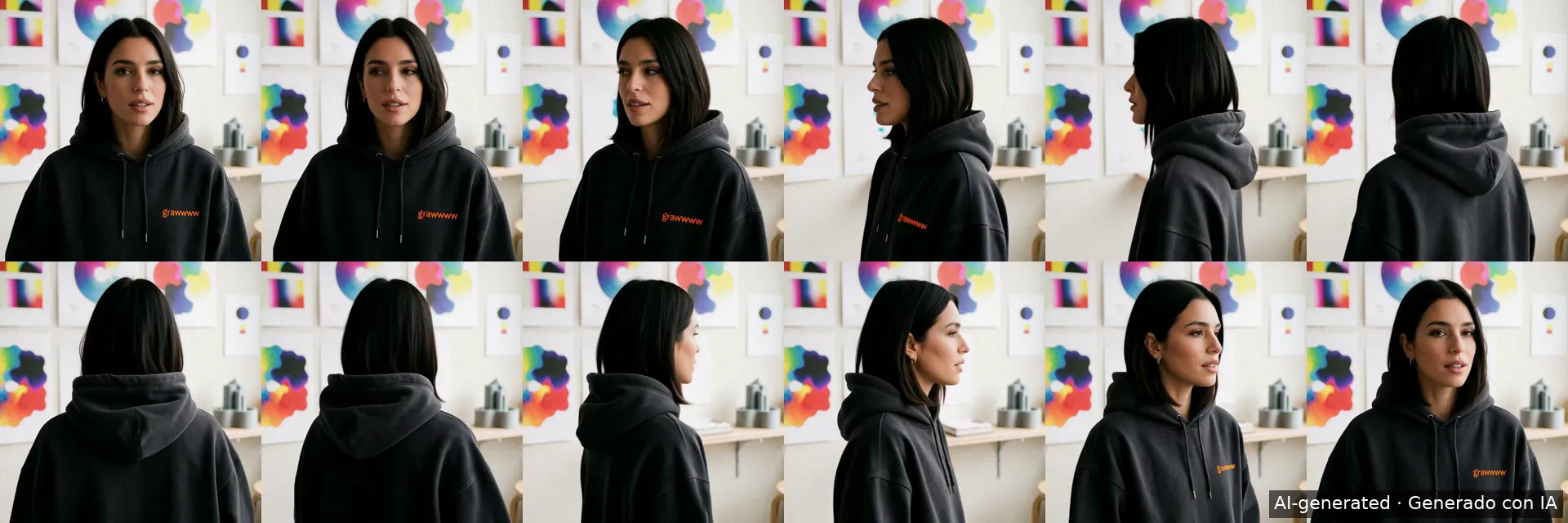
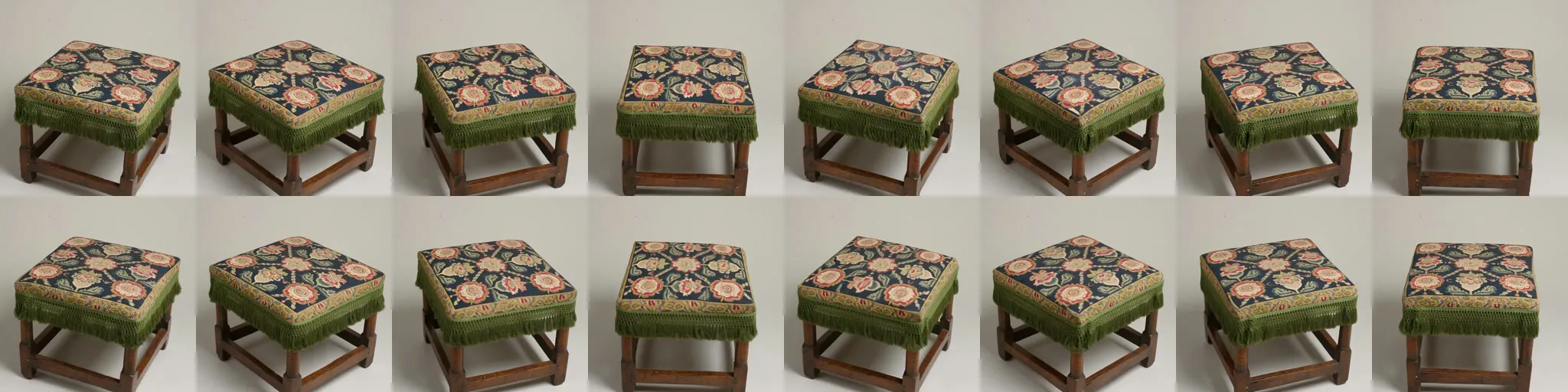
On the presenter and on the stool, the clip turns a full 360° and the last frame returns to the start pose. On the stool, the cushion pattern, the legs and the fringe really rotate; it is not a wobble. On the presenter, face, hair and hoodie colour hold.
The control confirms where the turn comes from. Without the LoRA the stool stays frozen: only film grain moves. Measured as "how far the image gets from frame 0", the control's maximum deviation is 2.75 (0–255 scale), against about 32 on the stool clips with the LoRA. (These are pixel statistics, not a quality verdict.)
What we added: an 8-step turbo LoRA
Pablo Dawson did not test his LoRA with any speed-up LoRA. We stacked his (strength 1.0) with an 8-step turbo LoRA from LightX2V (Minimax-h3-Turbo, Apache-2.0 per its model card; because it is an adaptation of MiniMax H3, we treat it as also subject to the MiniMax H3 Community License; strength 1.0) and used 8 steps instead of 28.
| Card (28 steps) | Orbit + turbo (8 steps) | |
|---|---|---|
| Wall time, mean | 140.9 s (5 runs; the first run of the session is excluded because it includes model loading) | 62.0 s (6 runs) |
| Sampler time | about 111–112 s | about 31–32 s |
| Peak VRAM | 23.4 GiB | 23.4 GiB |
"Wall time" is from sending the job to ComfyUI until the result is ready. "Sampler time" is the sampling loop only, from the ComfyUI log. Peak VRAM is total GPU memory seen by nvidia-smi (sampled every 0.5 s), including a small desktop baseline. All on one RTX 4090, 768×768, 73 frames.
In all 6 pairs (3 inputs × 2 seeds), the same seed gives the same trajectory and the same content at 28 steps and at 8. The only difference the reviewer saw was slightly softer texture. So: about 2.3 times less wall time, with the same visible result on this sample.
Where it breaks
1. The unseen side is invented, and it depends on the seed. The presenter input only shows the small chest logo. With seed 42, in both variants, the model drew a large orange logo across the back of the hoodie. With seed 777 the back stayed plain. If the real back of a product matters, what you get is fiction.
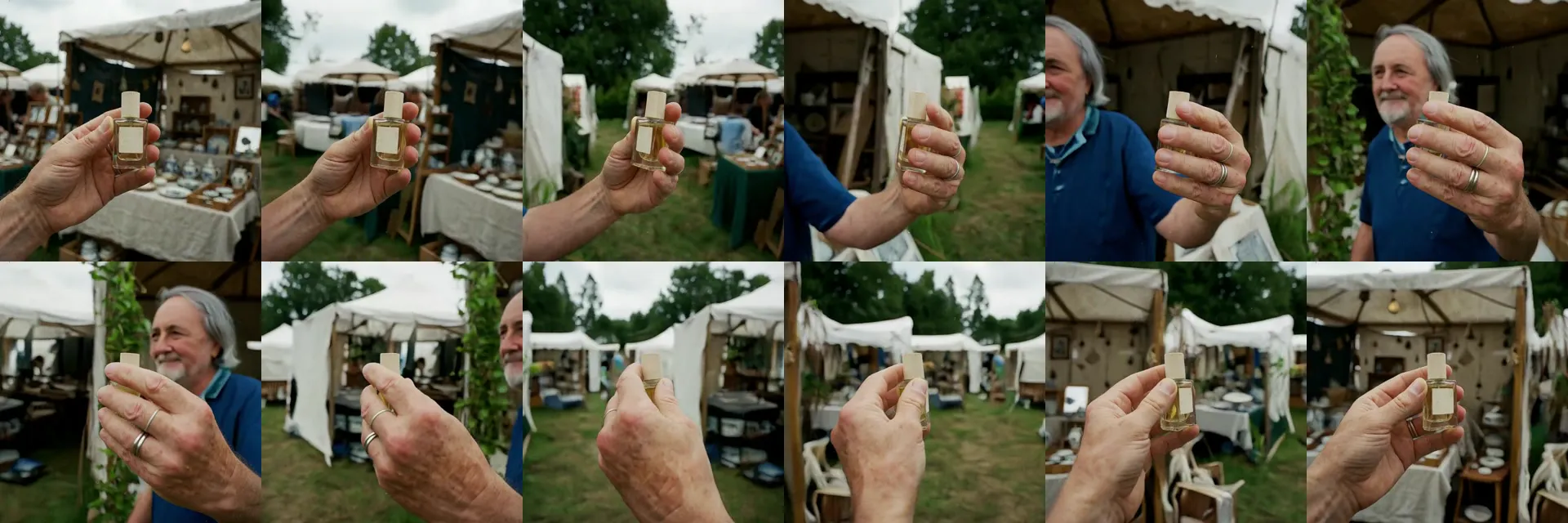
2. A product held in a hand, in a busy scene, is unstable. On the perfume with seed 42, the motion was a sweep of about 90–100° of the stall and background, and the bottle barely turned; its back was never shown. With seed 777 it was the worst result of the test: the market turned into other places, a different man appeared, rings showed up on the fingers, and the bottle lost its shape and its label for half the clip. Then the shot came back to the original stall. At 8 steps, the same problem with the same seed.
3. It reads as the subject turning, not the camera orbiting. The background stays still, as if the person turned on the spot. Output is 768×768, and sharpness drops in the side views.
What it means for a client
For a product spin in an online shop, it is usable only with photos of the real back and sides, and every seed checked by eye. The model cannot know what is behind the subject. An isolated object on a plain background was the best result of the test (stool: 4 of 4 clips with a full turn that closes). For a product in a hand, we would not use it. We promise nothing beyond that.
Limits of the test: 3 inputs, 2 seeds, one GPU, one base model. The LoRA's author trained on 28 clips of people (human Gaussian splats) and says other subjects, aspect ratios and clip lengths are untested.
Licence and use
The base model and the orbit LoRA are under the MiniMax H3 Community License; the turbo LoRA is published under Apache-2.0, but it is an adaptation of H3 and we treat it under the same conditions. The licence forbids using the model or its outputs to improve other AI models (s. V.3). We do not.
This test is internal. We do testing, benchmarking and optimisation of locally run models for technical teams: Technical teams.
The videos and generated images in this article are AI-made; the stool input is a real public-domain (CC0) photo. The presenter is a synthetic person, not a real person. Stool: Stool, British, c. 1670, The Metropolitan Museum of Art, Bequest of Irwin Untermyer, 1973, accession 1974.28.25 (CC0, Met Open Access; Wikimedia Commons File:Stool_MET_DP159799.jpg). The perfume image is AI-generated. Orbit LoRA author: Pablo Dawson. 8-step turbo LoRA author: LightX2V (our file has the same name and size as the one in the repo lightx2v/Minimax-h3-Turbo).
Powered by MiniMax H3 (MiniMax). MiniMax H3 is licensed under the MiniMax H3 Community License Agreement. Not affiliated with MiniMax.
Another article: From 650 s to 72 s: reference-to-video on a single RTX 4090 →